
Why Horizontal Scaling Beats Bigger Servers
When your app starts getting real traffic, you usually have two options:
- buy a bigger server
- add more servers
At first, both sound reasonable.
But only one of them scales well when things get serious.
In this article, we will break down the difference between vertical scaling and horizontal scaling, when each one makes sense, and the one rule your system must follow if you want horizontal scaling to actually work.
#Start Simple: The Single-Server Design
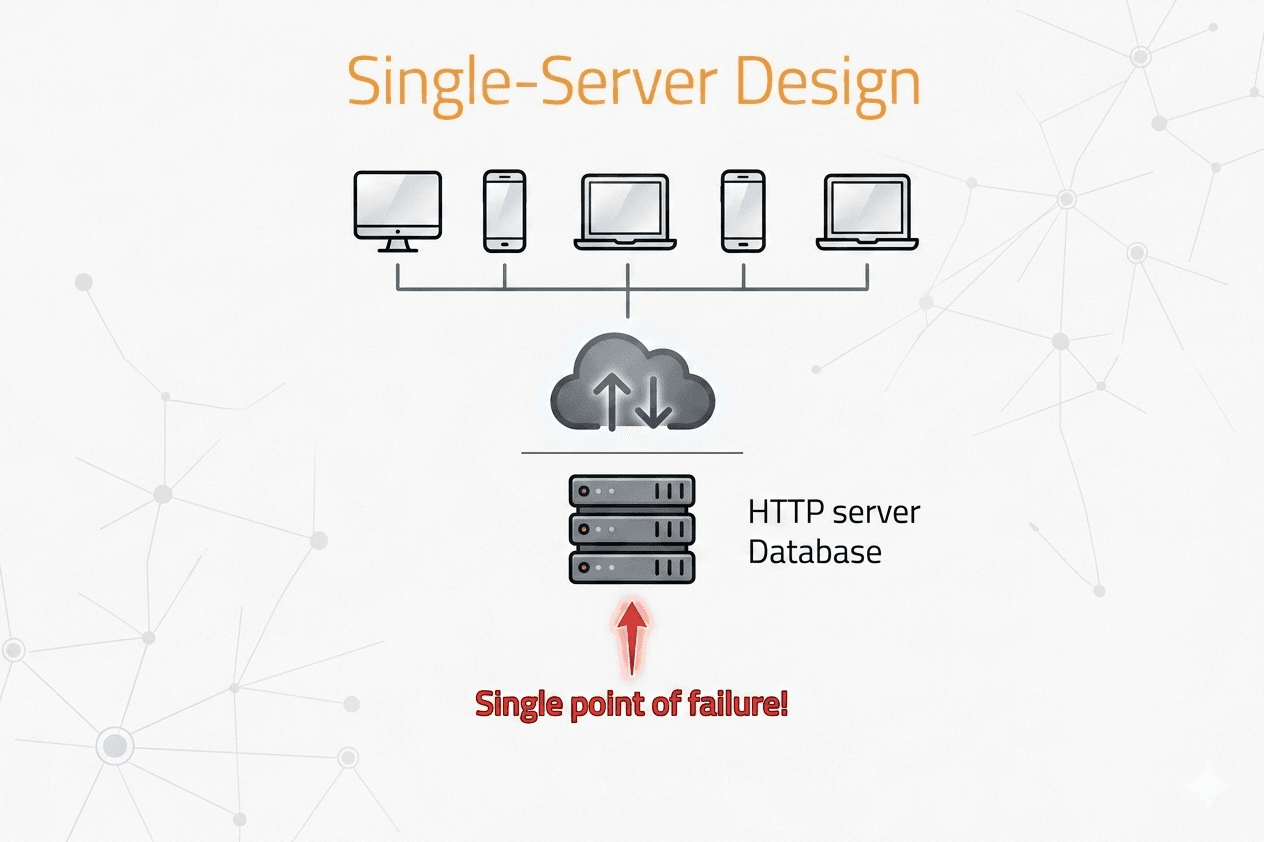
Let’s begin with the simplest setup possible.
You have users on the internet, and all of them talk to one server.
That server handles the web requests, and maybe it even runs the database too.
This is a totally valid setup for small projects:
- a personal website
- a tiny internal tool
- a side project that does not get much traffic
In fact, for something small, this is often the right choice.
Why?
Because it is:
- cheap
- easy to maintain
- low in operational complexity
But the weakness is obvious:
This one machine is a single point of failure.
If that server goes down, everything goes down.
Your website is offline.
Your app is offline.
Your users are stuck.
And even if it does not crash, it can still become overloaded.
Too many requests.
Too much CPU usage.
Too little memory.
Too many database operations happening on the same box.
So the single-server setup is simple, but it does not scale well, and it is fragile.
#First Improvement: Separate the Database
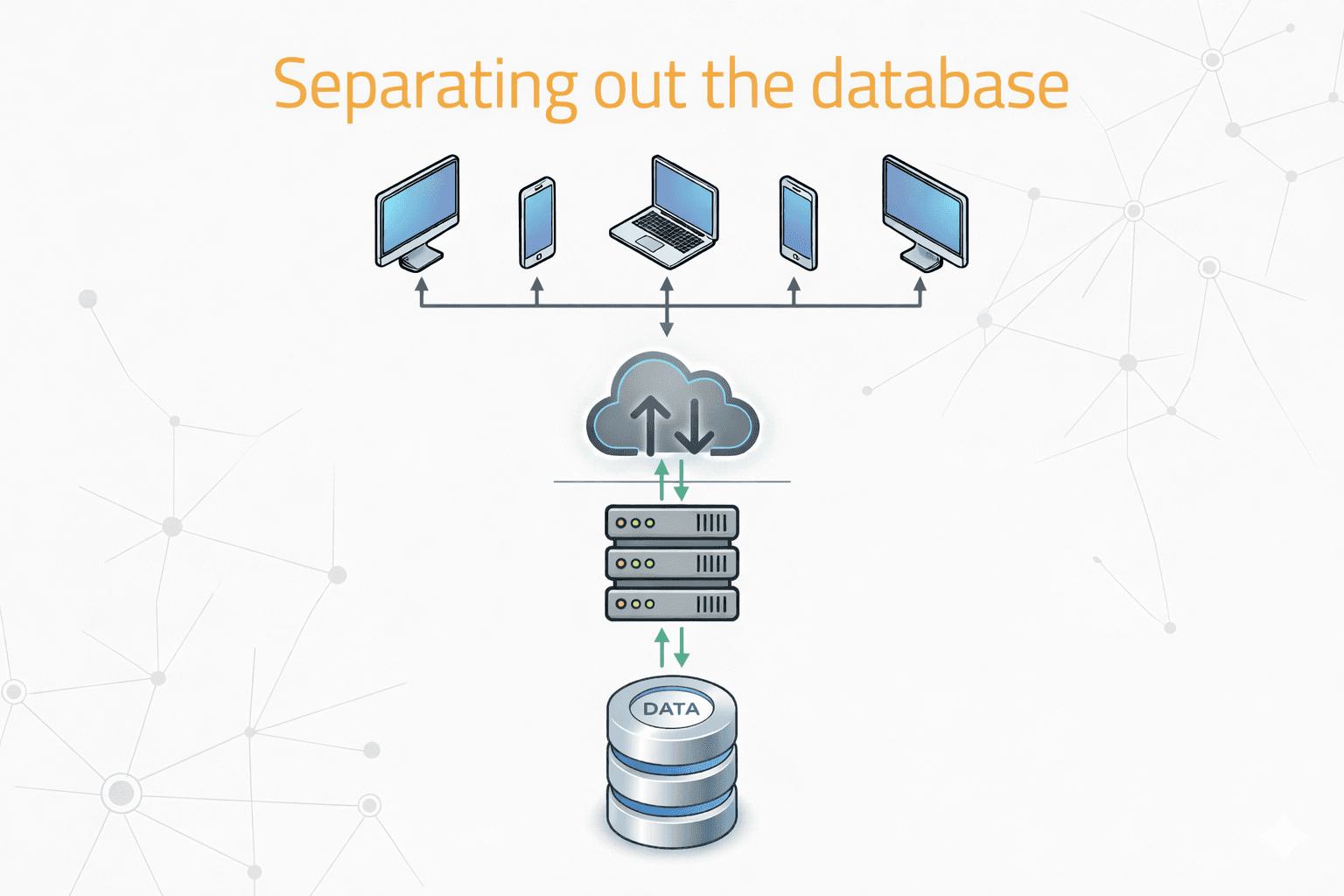
The next step up is to separate responsibilities.
Instead of one machine doing everything, you move the database to its own server.
Now you have:
- one server for the application
- one server for the database
This is already better.
Because now the web layer and the database layer can scale independently.
If your database queries are heavy, you can give the database a stronger machine.
If your application logic is relatively light, you do not need to overpay for the frontend server.
So this gives you more control.
But it still has a major weakness.
You now have two single points of failure.
If the app server dies, the service is down.
If the database dies, the service is down.
So yes, this is cleaner.
But it is still not what we would call truly scalable or resilient.
#Vertical Scaling: The Easy Upgrade
Now let’s talk about the first real scaling strategy:
#Vertical Scaling
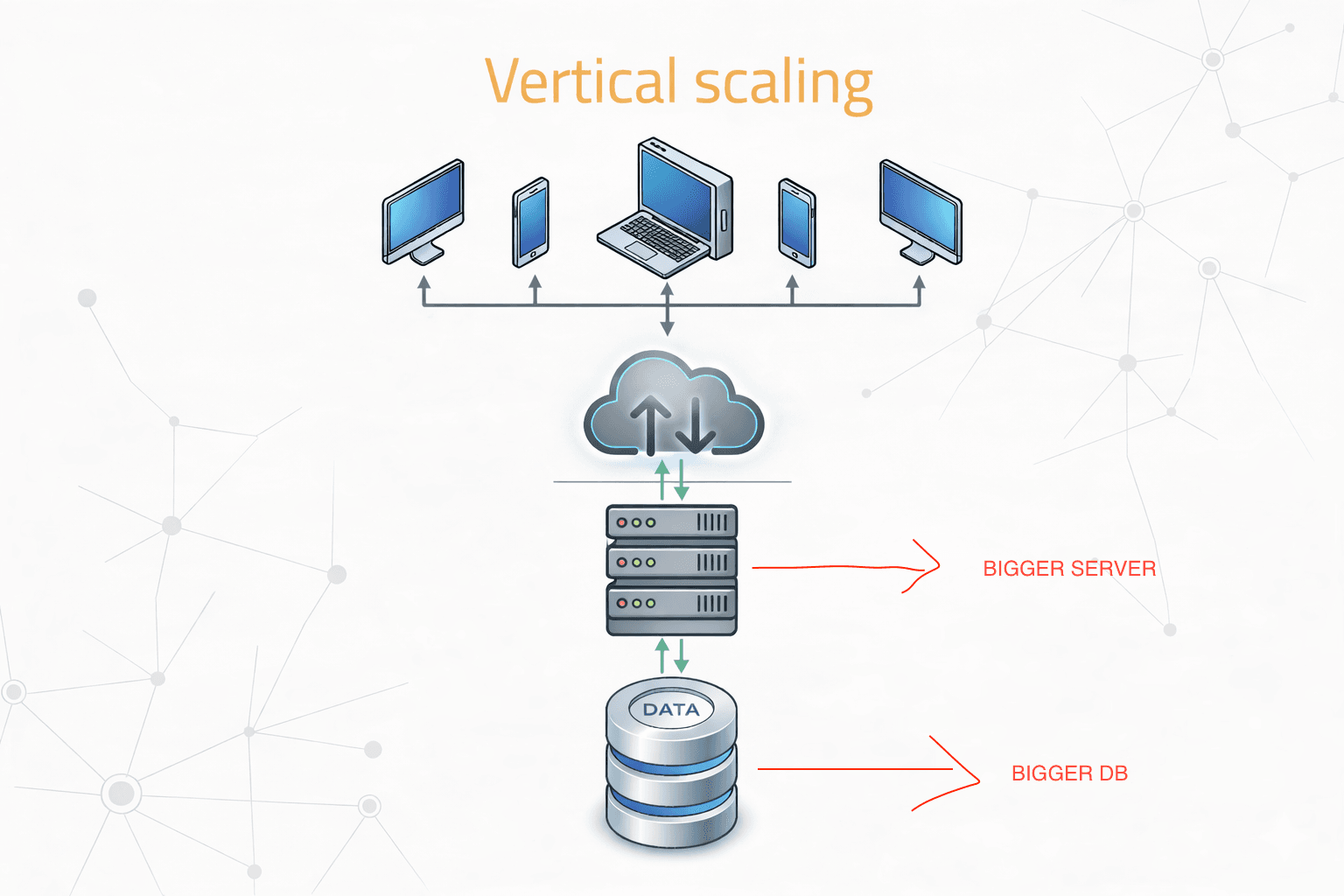
Vertical scaling means:
you do not add more machines.
You make the existing machine bigger.
That might mean:
- more CPU
- more RAM
- more storage
- a more powerful VM
- a more expensive database host
This works.
And honestly, it works more often than people think.
If your app starts slowing down, the fastest fix is often to just give it a bigger box.
That is vertical scaling.
It is:
- simple
- fast to apply
- easier operationally than redesigning your whole architecture
That is why many systems begin this way.
But vertical scaling has limits.
A server can only get so big.
A database machine can only get so powerful.
At some point, you hit a wall.
And even worse, you still depend on that one machine.
So if it fails, you still have downtime.
That is the tradeoff.
Vertical scaling is simple, but limited.
It buys you time.
It does not solve the deeper scaling problem.
#Horizontal Scaling: The Modern Approach
Now we get to the architecture most people mean when they talk about systems at scale:
#Horizontal Scaling
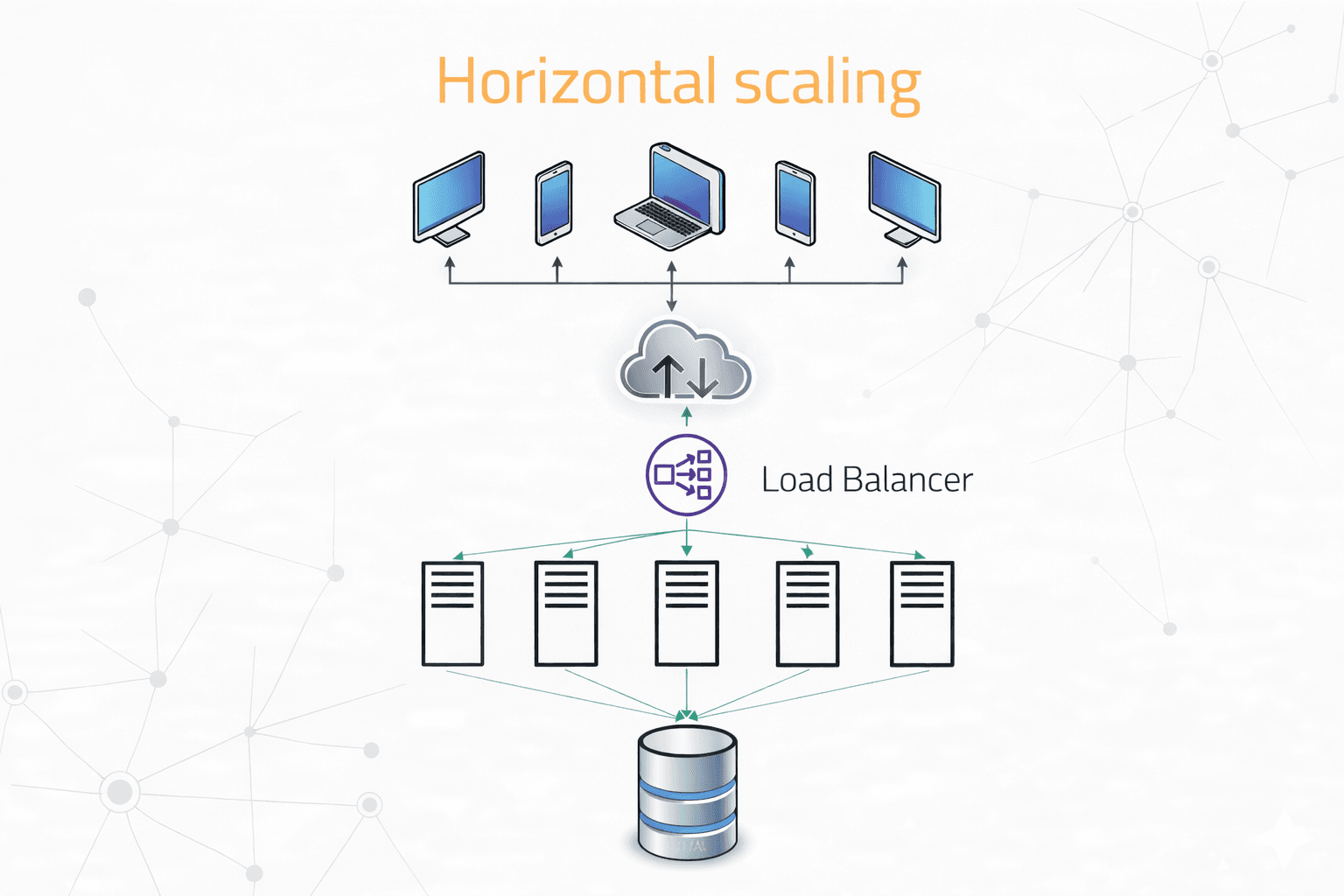
Horizontal scaling means:
instead of using one bigger server, you use many servers.
Now users do not talk directly to one application server.
Instead, their traffic first hits a load balancer.
And that load balancer distributes requests across multiple servers.
So instead of:
users -> one server
you get:
users -> load balancer -> many servers
This changes everything.
Because now, if traffic increases, you do not need a giant machine.
You can just add more servers to the pool.
And if one server fails, the load balancer can stop sending traffic to it.
The system keeps running.
That is the real power of horizontal scaling:
- more capacity
- better resilience
You are no longer betting your whole product on one machine being perfect.
You spread the work across many machines.
That is why modern internet systems lean heavily in this direction.
Not because it is trendy.
Because it is practical.
When traffic grows, horizontal scaling gives you a much better path forward than endlessly buying larger and larger servers.
#The Catch: Your App Must Be Stateless
But there is one very important catch.
Horizontal scaling only works well if your application servers are stateless.
This is one of the most important ideas in system design.
Stateless means:
any server should be able to handle any request at any time.
In other words, the server should not depend on local memory from a previous request.
Why?
Because with a load balancer, the same user might hit a different server on the next request.
For example:
- request one might go to server A
- request two might go to server C
- request three might go to server B
So if server B needs information that only exists in the memory of server A, your system breaks.
That is why state cannot live inside random app servers if you want clean horizontal scaling.
Shared state should live in systems like:
- a database
- a distributed cache
- session storage
- another shared backend service
The app servers themselves should stay replaceable.
That is the idea.
Any request, any server.
That is what makes the architecture scalable.
#When Should You Use Each?
So how do you choose?
Here is the practical rule:
Use the simplest architecture that meets your real requirements.
If you are building a tiny project with low traffic and low business risk, a simple single-server setup may be completely fine.
If your system is growing and you need a quick performance improvement, vertical scaling can buy you time.
But if you are building something that needs to handle serious traffic, survive failures, and grow over time, you usually move toward horizontal scaling.
Not because it is more impressive.
Because it is more realistic for systems that cannot afford to go down.
So do not overengineer too early.
But also do not pretend a giant single box is a long-term scaling strategy.
#Final Takeaway
The core idea is simple:
- Vertical scaling = bigger machine
- Horizontal scaling = more machines
Vertical scaling is simpler, but limited.
Horizontal scaling is more powerful, but requires better architecture.
And the key requirement for horizontal scaling is simple:
your services need to be stateless.
If you understand that, you are already thinking much more like a real system designer.